What is the number z such that z^n gives us the original number? By the fundamental theorem of algebra, we know there ar exactly n n-th roots in \mathbb C.
Consider the n-th roots of z = re^{i\theta}, for z \in \mathbb C_*. That is, we want all w \in \mathbb C such that w^n = z. Notation: \exp (\xi) = e^\xi.
Then, we can use de Moivre’s theorem “in reverse” to see that z has n distinct roots: \left\{ r^{1/n}\exp\left(\frac{i\theta}n\right), r^{1/n}\exp\left(\frac{i\theta}n + \frac{i2\pi}n\right), \ldots, r^{1/n}\exp\left(\frac{i\theta}n + \frac{i2\pi(n-1)}n\right) \right\}
B.C. 13 (8th ed 12-13)
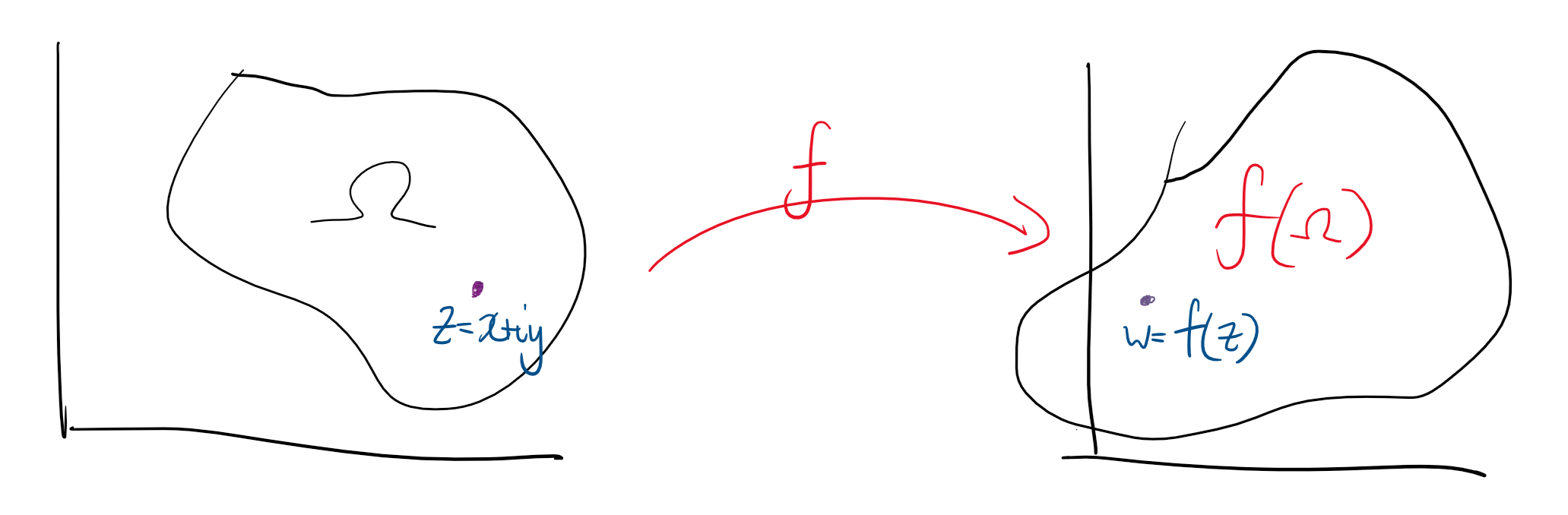
Suppose we have \Omega \subseteq \mathbb C and a function f : \Omega \to \mathbb C can be viewed as a mapping on \Omega, the domain of f. If \Omega is not specified, then we take \Omega to be as large as possible.
Example: For f(z) = 1/z we can take \Omega = \mathbb C \setminus\{0\}, so f : \mathbb C_* \to \mathbb C. As notation, we can also write f : z \mapsto 1/x, or w=1/z, or just 1/z if the meaning is clear.
The usual notation is w : (x,y) \mapsto (u,v), i.e. w(x+iy)=u(x+iy)+iv(x+iy) or w(x,y)=u(x,y)+iv(x,y).
This notation is not completely rigorous; u is both a function from \mathbb C and from \mathbb R^2. We could introduce a map \varphi : (x,y)\mapsto (x+iy) but this is excessively verbose. There is no real problem with this, but be aware.
Examples: - Consider f(z) = 1/z. \operatorname{dom}f = \mathbb C_\star. f^{-1}(\xi)=1/z is a function \mathbb C_* \to \mathbb C_*. - For g(z) = 1/(1-|z|^2). \operatorname{dom}g = \mathbb C \setminus \{z : |z| = 1\}. The function is g : \{z : z \ne 1\} \to \mathbb R. The inverse is not a function. - For h(z) = z^n where h : \mathbb C \to \mathbb C, the inverse is also not a function.
Let’s aim to get a geometric picture of what a given f does.
Examples: - w = 1+z moves each point one unit to the right (in the positive real direction). - re^{i\theta} \mapsto re^{i(\theta+\pi/2)} rotates points through an angle of \pi/2 in the counter-clockwise direction about the origin.
For new and unfamiliar mappings, break them down into compositions of known or easy maps.
Examples: - w = Az + b where A, b \in \mathbb C and A \ne 0. We can think of A as a dilation and rotation, then +b as a translation. - For z \mapsto Az, write A=a e^{i\alpha} for \alpha, a \in \mathbb R. This gives us re^{i\theta}\mapsto ar e^{i(\theta+\alpha)}. Specifically, it dilates the modulus by a factor of a=|A| and rotates through \alpha = \arg A. - For z \mapsto z+b where b = b_1+b_2i, b_1, b_2 \in \mathbb R. This translates b_1 to the right and b_2 up. If negative, goes in the opposite direction.
Note: The maps above have domain and image \mathbb C.